Turner & Townsend - Designing a contracts and risk platform for a global consultancy
ROLE: Lead UX Designer
DATE: October 2025 – February 2026
Turning dense legal and governance complexity into a usable end-to-end workflow
SUMMARY
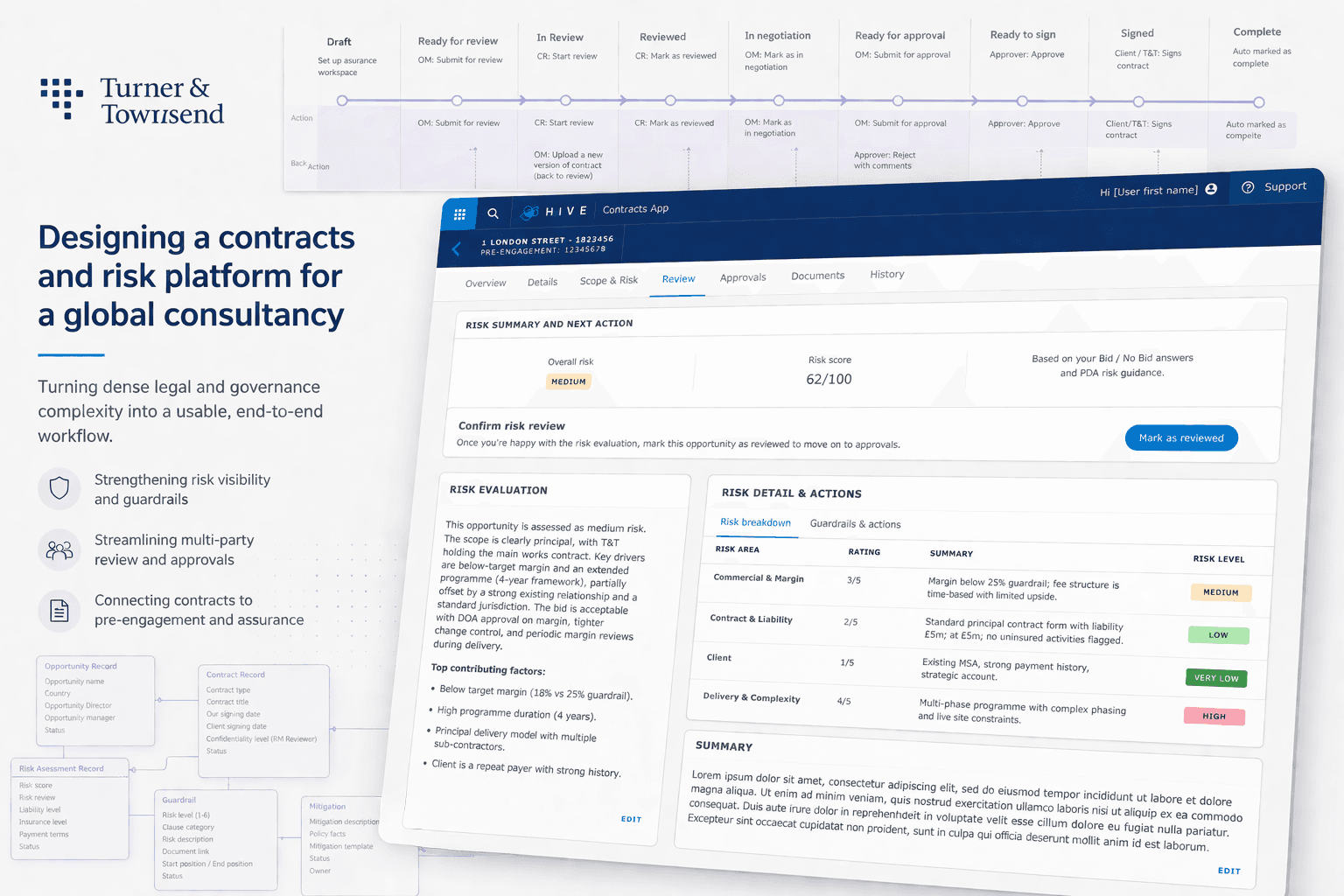
I joined Turner & Townsend as Lead UX Designer on a new contracts platform connected to pre-engagement and Assurance. The goal was to bring structure and usability to a complex contract and risk process that was spread across spreadsheets, email chains, legacy tools and offline reviews.
The platform needed to support multiple contract types, approval routes, risk guardrails and links between upstream and downstream agreements, while also working for the people using it day to day. My role was to turn that legal and governance complexity into something clearer, more structured and more buildable.
THE CHALLENGE
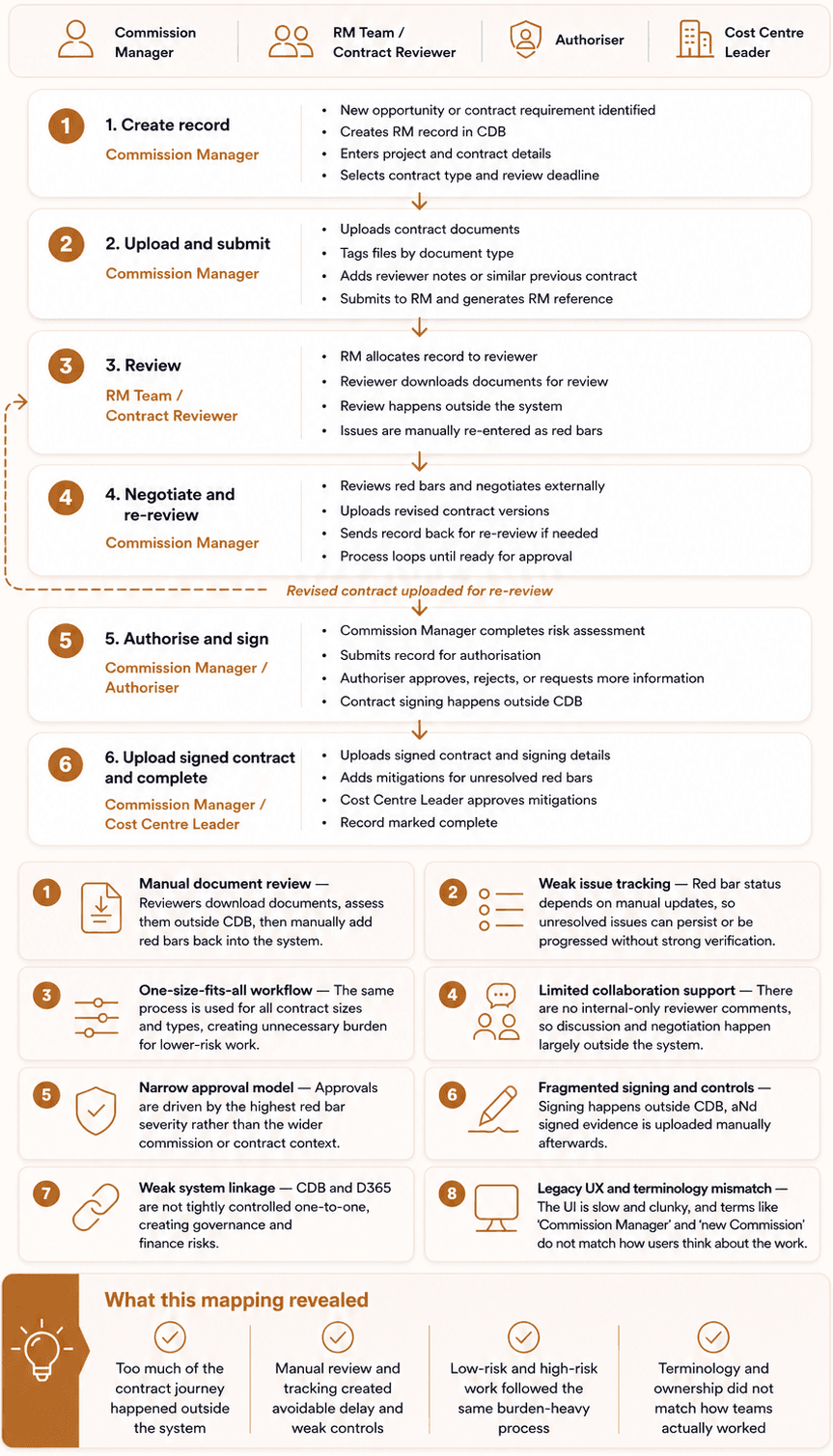
Turner & Townsend manage contracts across multiple regions, services and partner organisations. That meant the platform had to support a wide range of scenarios, including MSAs, call-offs, standalone contracts, NDAs, upstream and downstream relationships, and working-at-risk cases.
At the same time, the Hive ecosystem was already live. So this was not a greenfield UI exercise. I needed to work within an existing framework, reuse established patterns where possible, and design new components only where the workflow introduced genuinely new needs.
The challenge was to create a shared, usable model for the full lifecycle — from contract creation through review, approval, signing and handover — without oversimplifying the governance behind it.
WHAT I DID
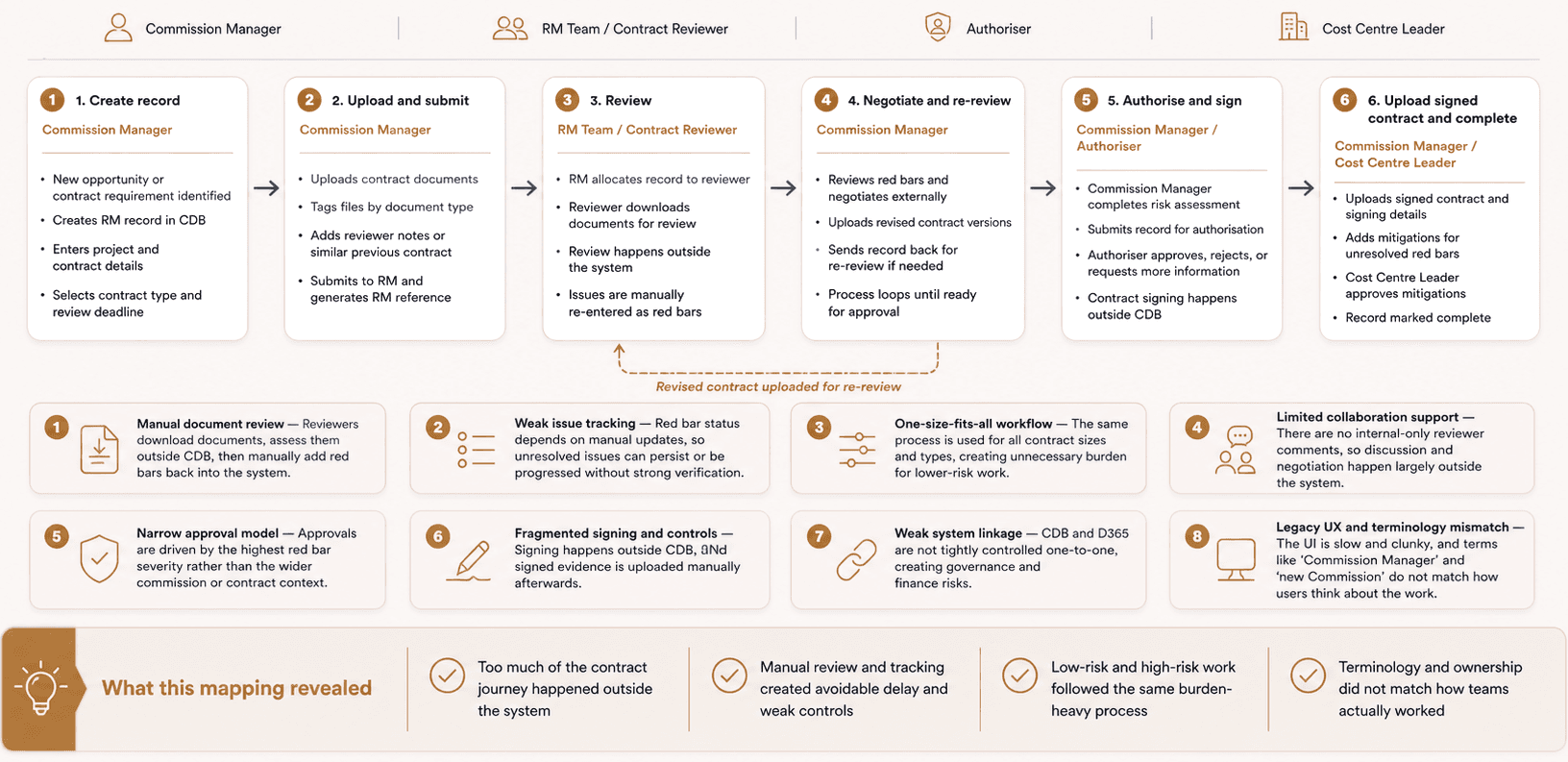
I started by learning how the combined business operated: the different business types, sectors and contract models in use, and where terminology overlapped or conflicted.
Throughout discovery, I ran regular research and validation sessions every week with product groups, SMEs and stakeholders to understand how contracts were actually being created, reviewed, negotiated, approved and signed across the business. That work helped surface differences in terminology, duplicated contract types, regional variation and gaps between formal process and day-to-day practice.
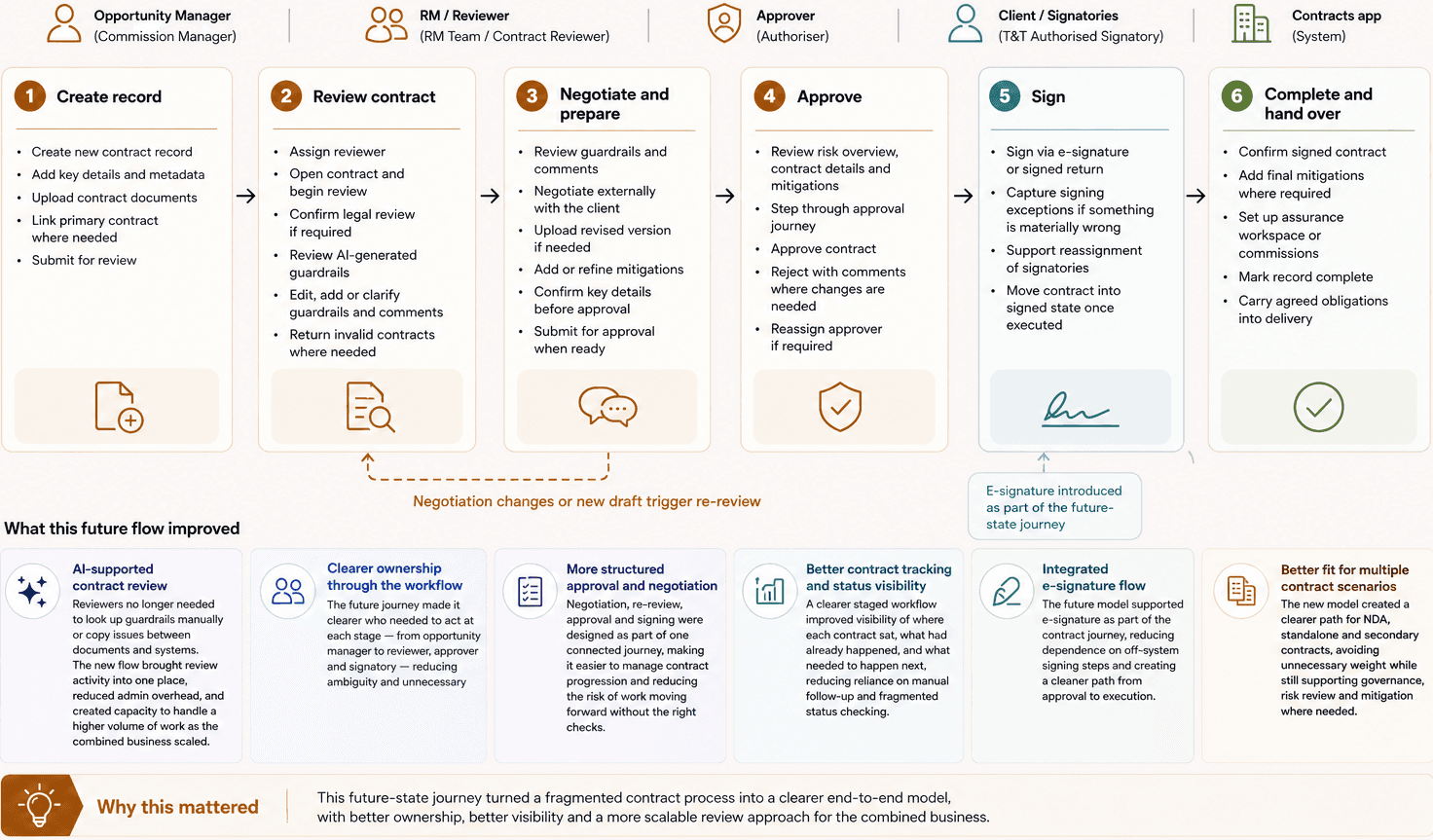
From there, I identified and de-duplicated the main contract types, then mapped high-level flows for each major scenario. These were reviewed and refined collaboratively before I developed more detailed user flows showing the steps, decisions, edge cases and ownership through review, negotiation, approval, signing and mitigation.
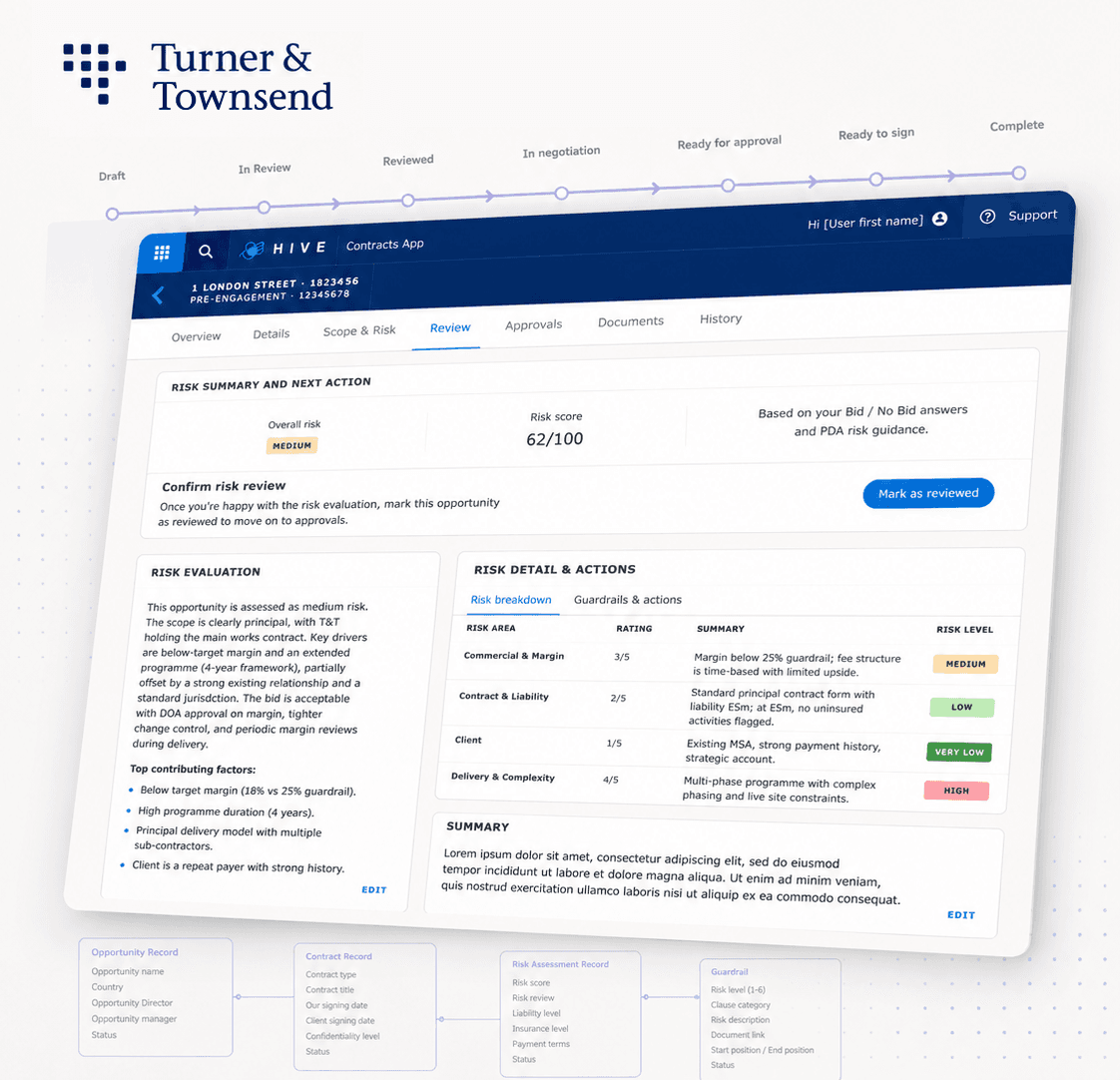
In parallel, I mapped PDA — the governance flow used by PJM for early delivery-risk approval — to understand how pre-engagement risk and principal delivery approval connected to the future contract journey. I then helped shape a to-be version and designed Hive-aligned screens for further validation.
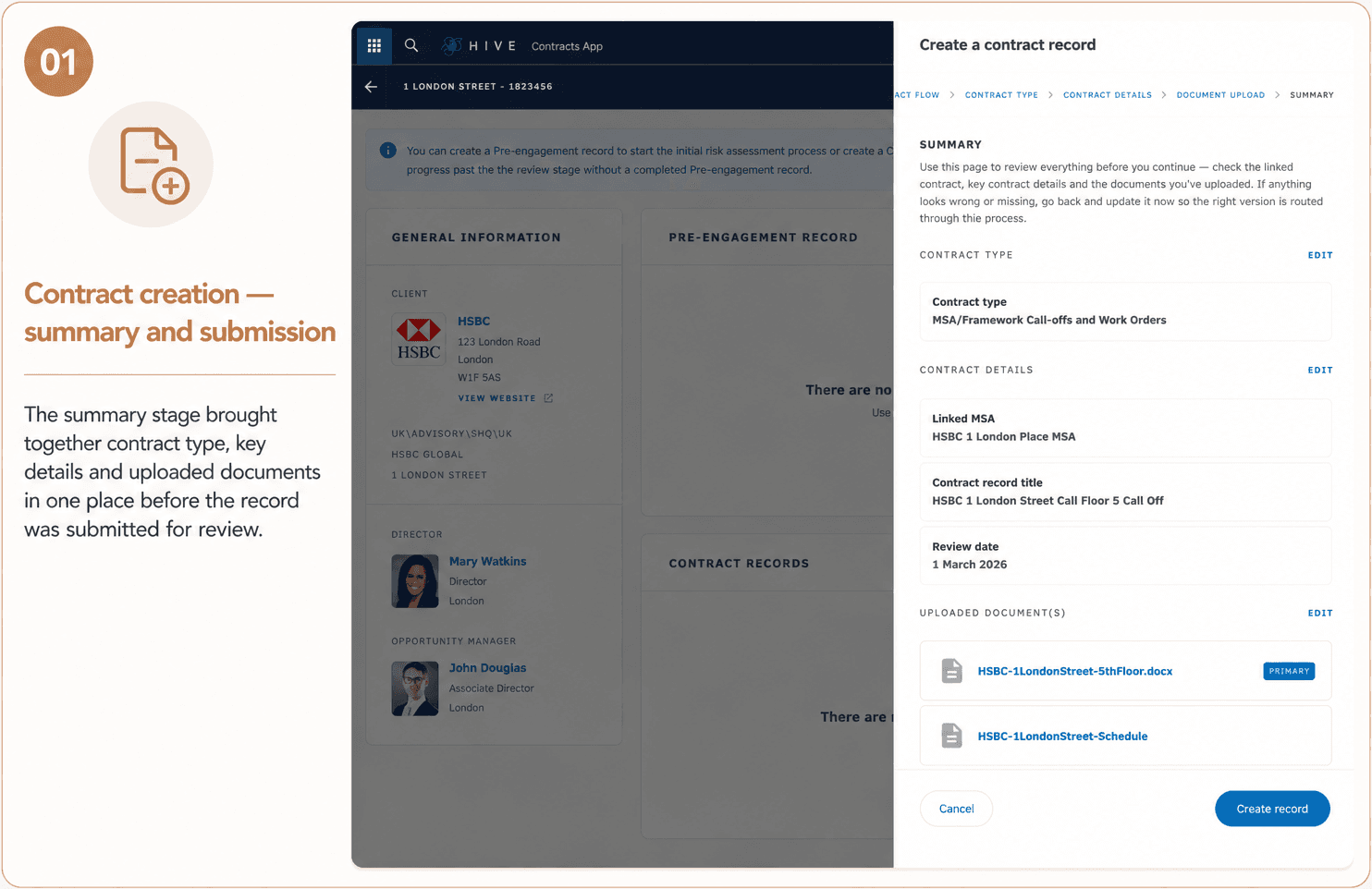
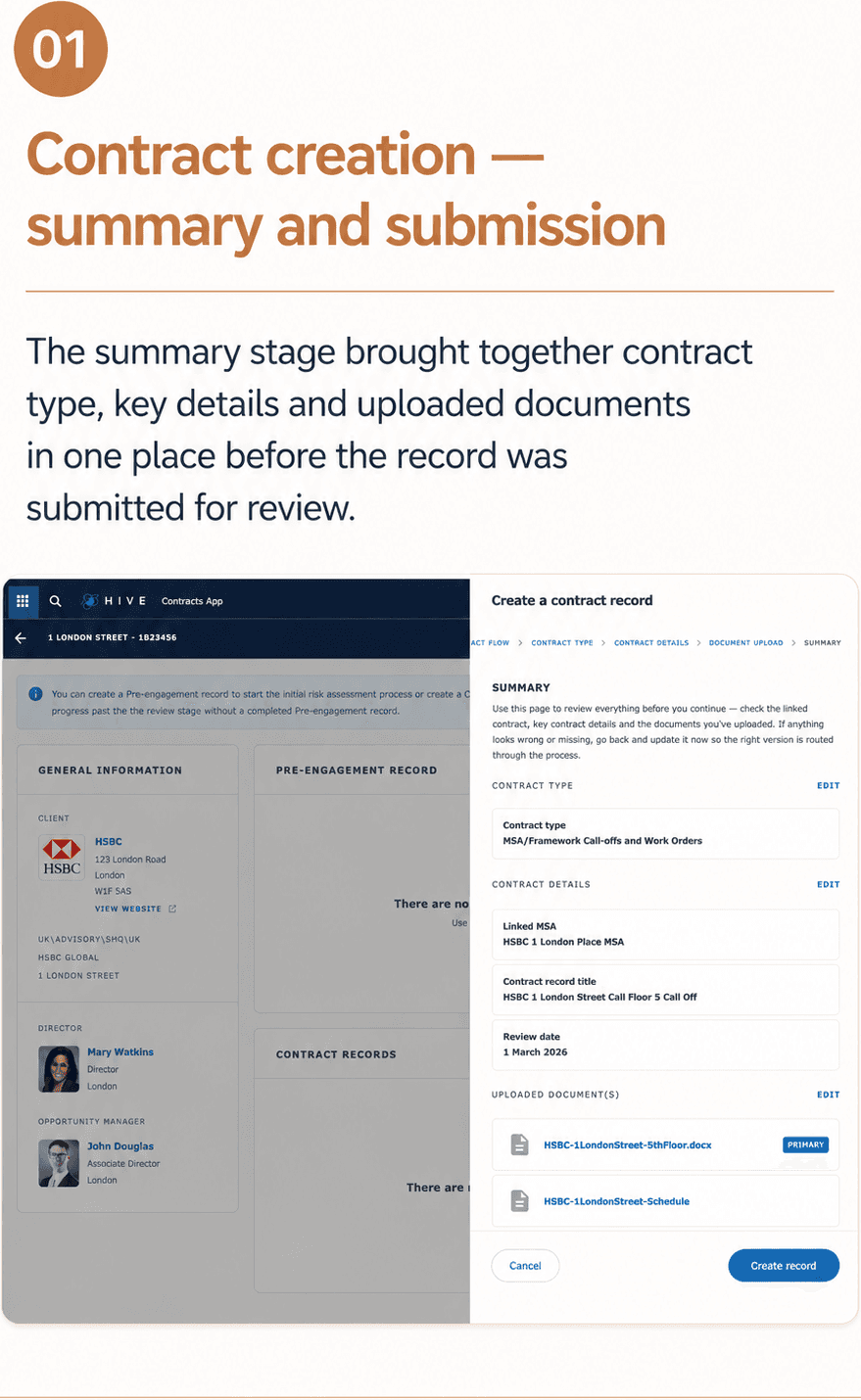
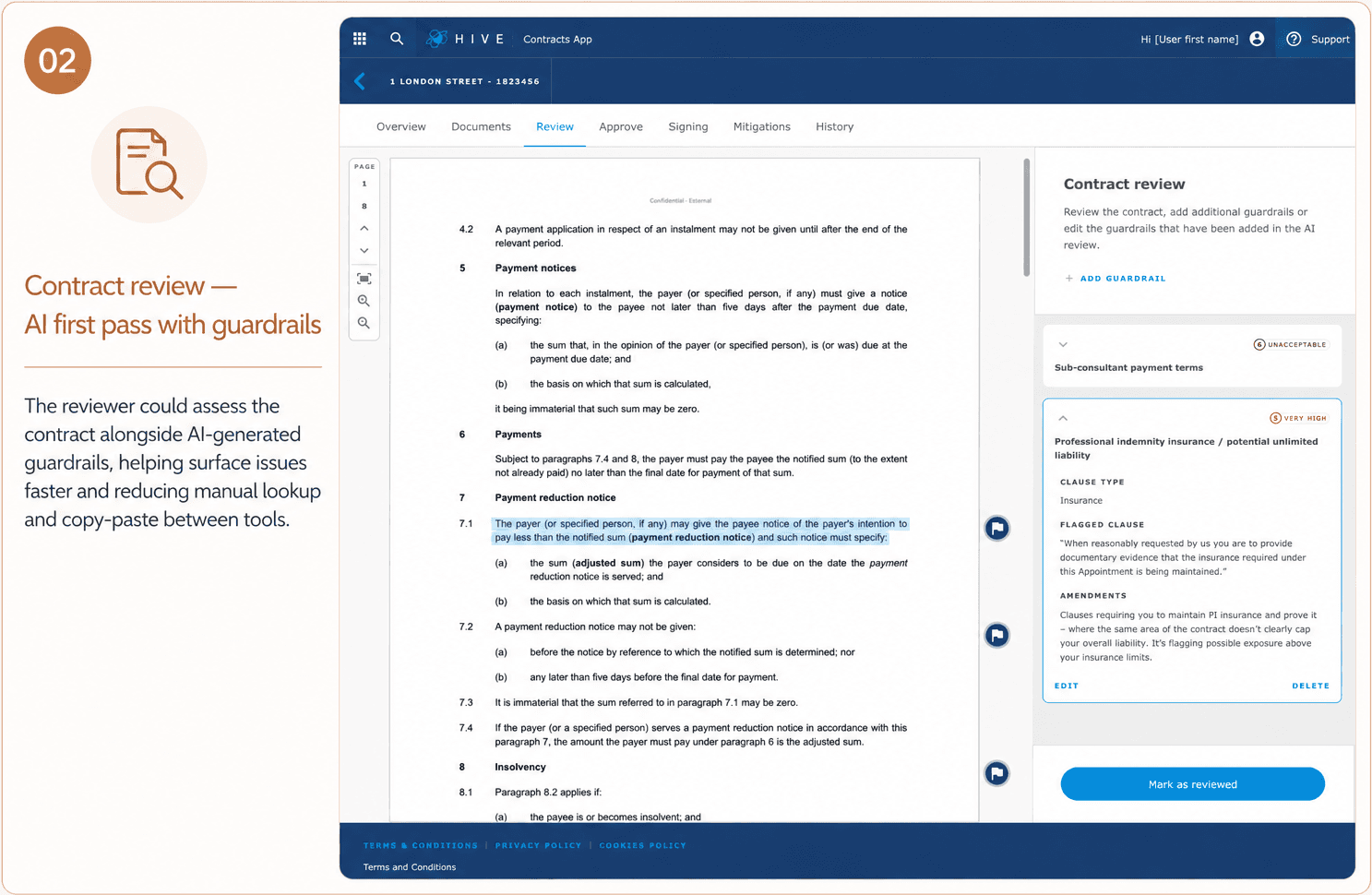
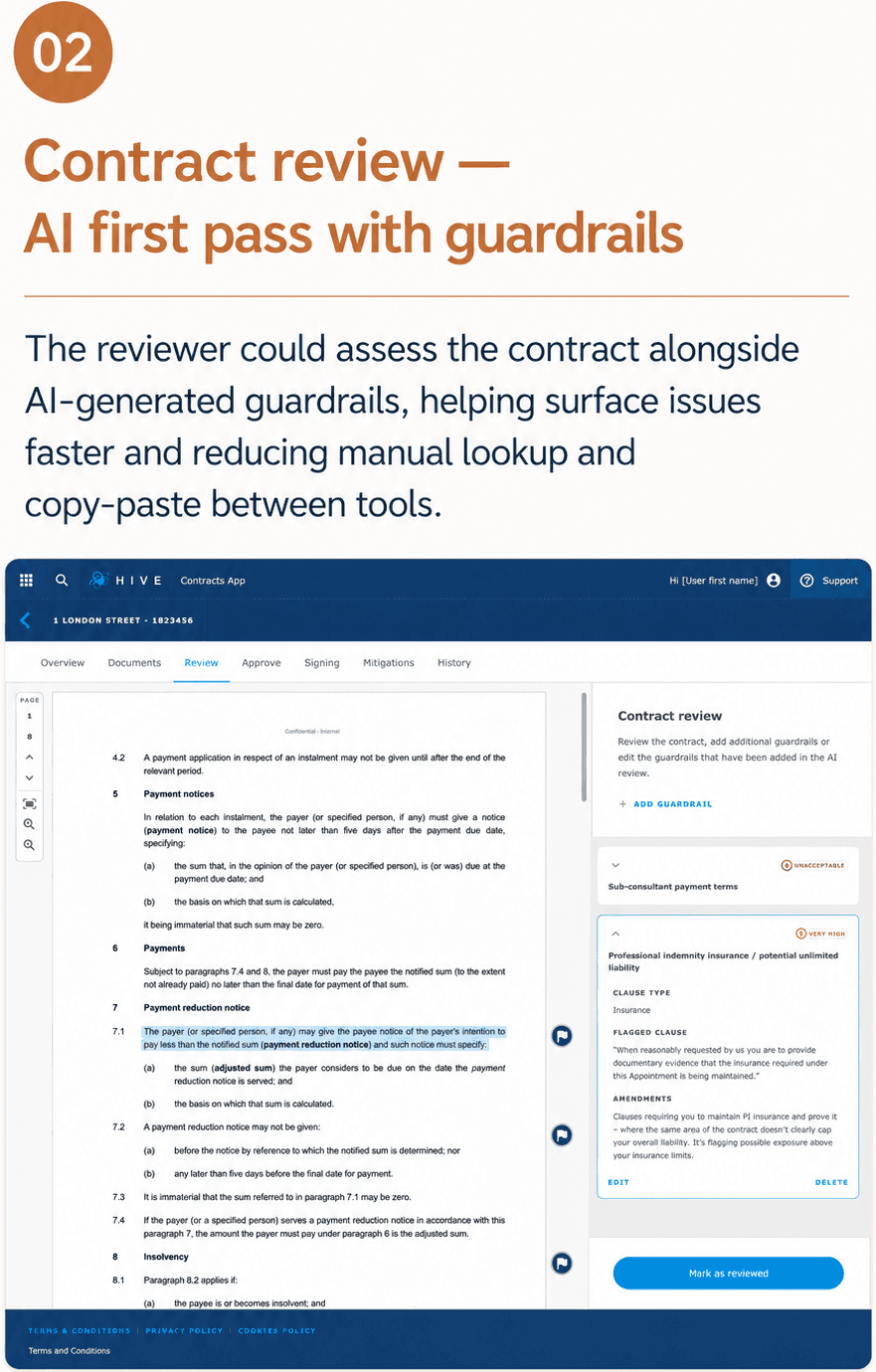
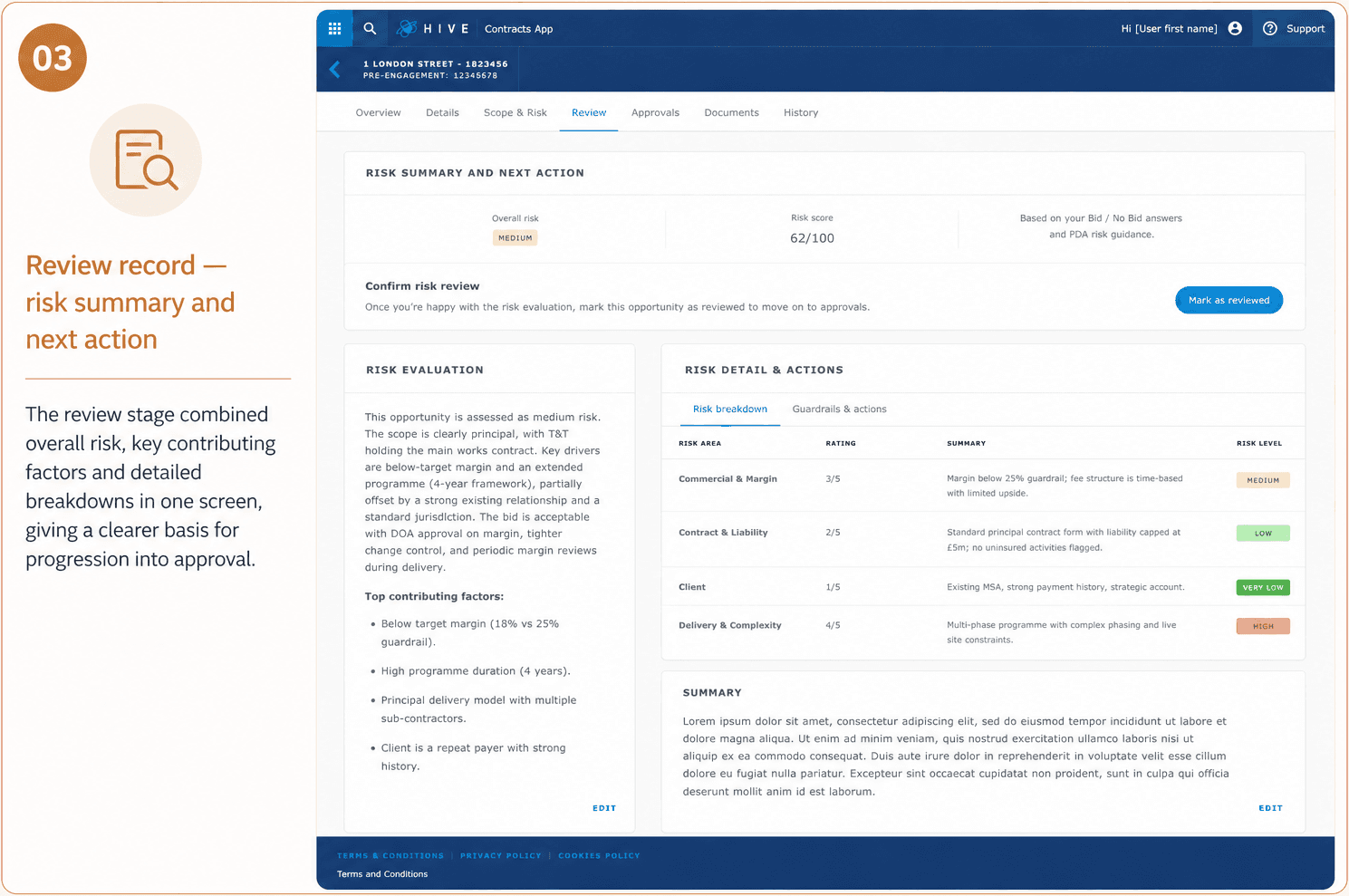
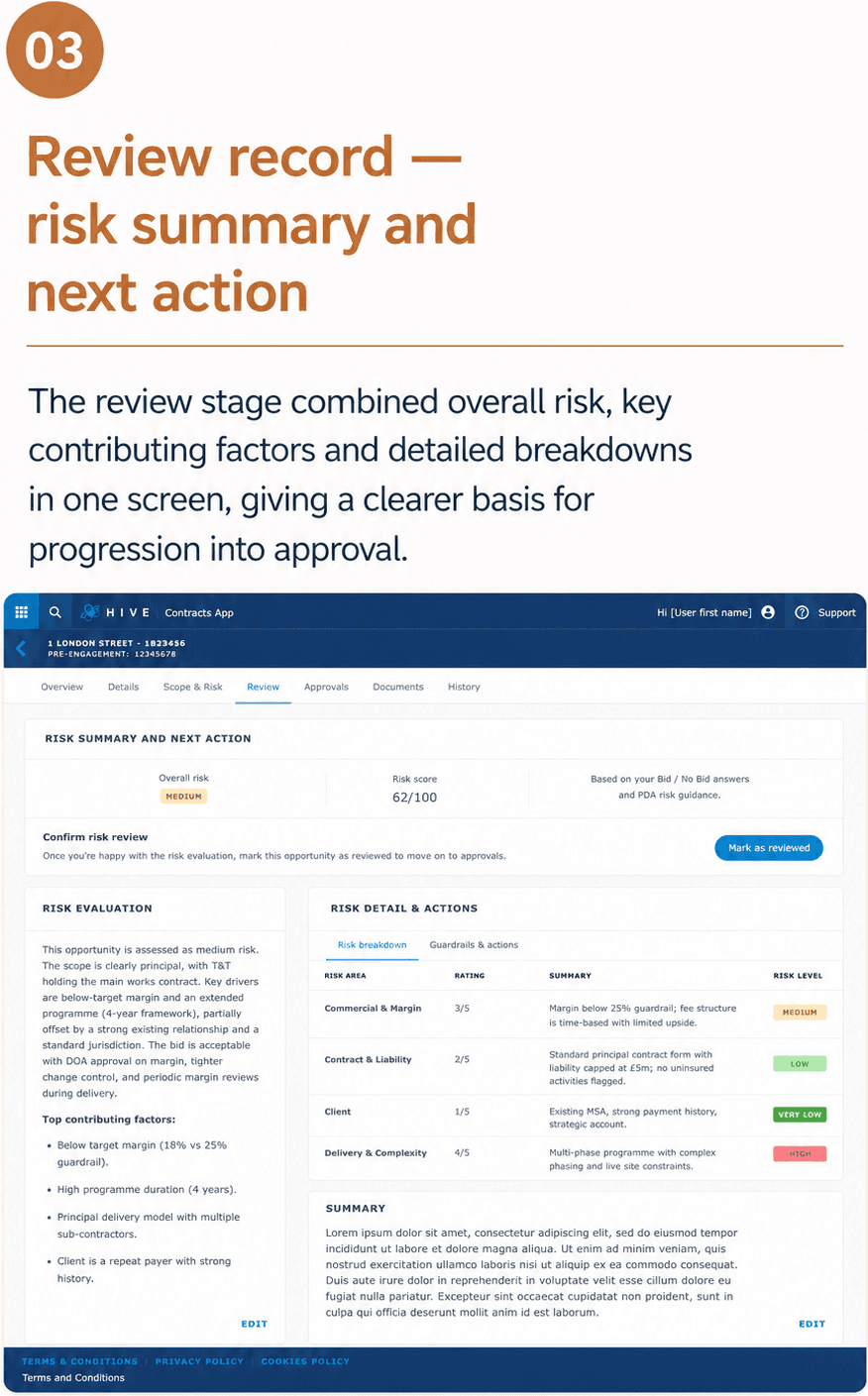
Once the journeys had been agreed, I translated them into screen flows, prototypes and reusable UI patterns for contract creation, document upload, linking contracts, guardrails, mitigations, approval journeys and working-at-risk scenarios. These were then validated repeatedly through further stakeholder reviews and tested with real day-to-day users, not just senior stakeholder groups, to make sure the workflows were usable in practice.
TO BE FLOW
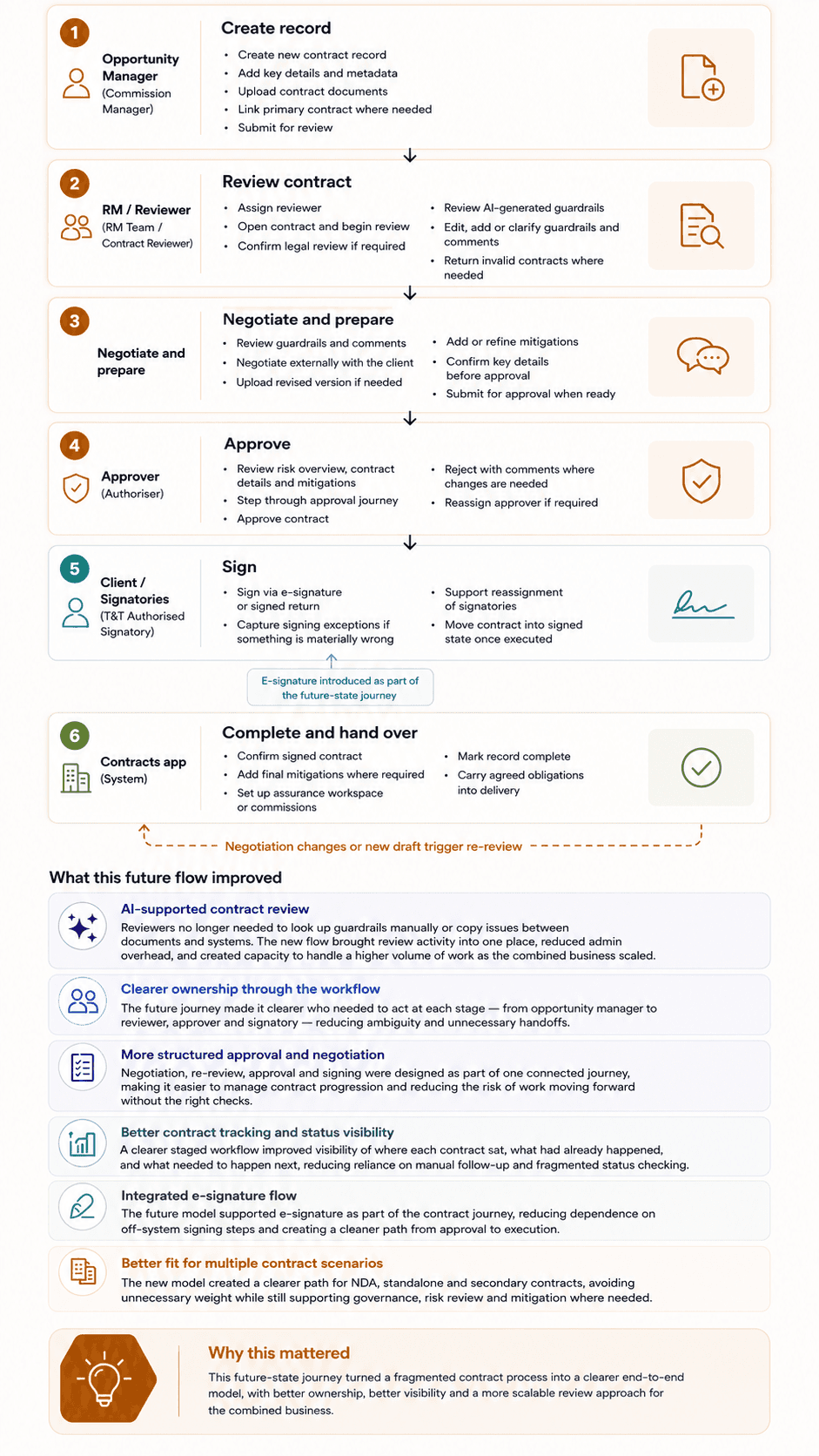
To-be contract journey - NDA / standalone / secondary contracts
Future-state journey mapped and validated across stakeholders before translating key stages into Hive-aligned screens and prototypes.
OUTCOME
By the end of the engagement, the project had produced:
a shared and documented contract lifecycle
clearer terminology and rationalised contract types across stakeholders
validated flows for major contract scenarios
reusable patterns for contract creation, review, approval and mitigation
early thinking for how adjacent governance flows such as PDA could connect into the future model
The work brought much more clarity to a highly governed, multi-persona workflow and gave product, legal, risk and engineering teams a stronger foundation to build from.
WHAT THIS SHOWS
Strong enterprise UX for complex governed workflows
The ability to balance usability with legal and operational constraints
Systems thinking across journeys, IA and data structures
Good judgement working within an existing design ecosystem
A mature approach to stakeholder validation versus real user testing
Strong enterprise UX for complex governed workflows